


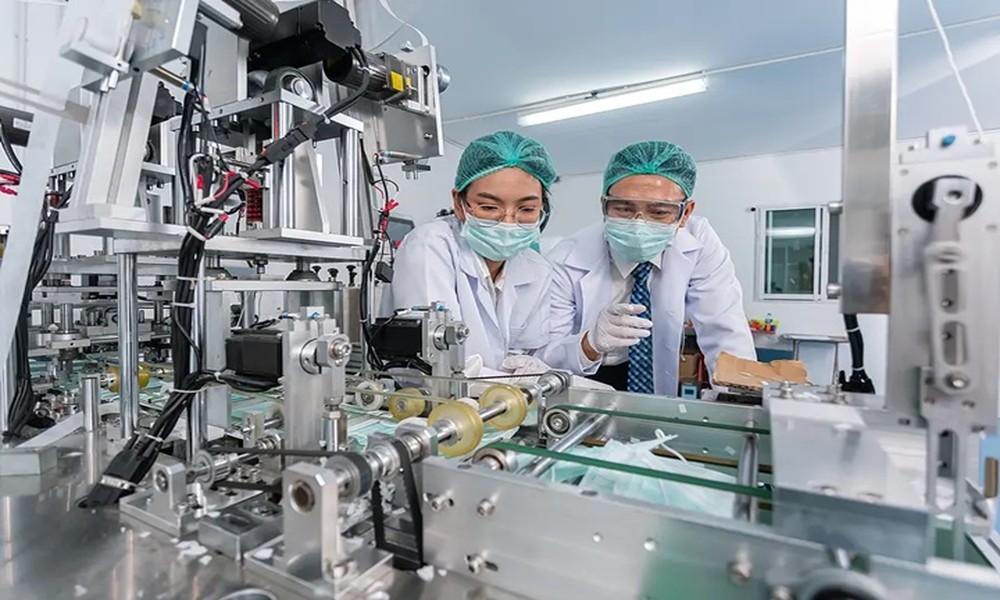
The defining feature of medical device manufacturing is that the object being produced must survive not only its intended use but also every audit, recall investigation, and regulatory inspection that might follow it for the next decade. A stamped bracket on a consumer appliance is judged by whether it holds. A stamped bracket inside a dialysis machine is judged by whether every decision that led to its production can be reconstructed from records, traced back through supplier lots, and defended in front of a notified body. That second standard is what shapes the industry, and it shapes it completely.
Compliance as an Architecture, Not a Checklist
It is tempting to view regulatory compliance as a set of documents produced alongside manufacturing. In practice, the documents are the manufacturing. A validated process that has not been recorded is, in regulatory terms, indistinguishable from no process at all. This inversion shapes how capable producers organise their facilities.
The governing frameworks for Medical Device production operate at several levels:
- ISO 13485 defines the quality management system requirements, covering design control, purchasing, production, and post-market activity
- FDA 21 CFR Part 820 applies to devices entering the United States market and maps closely to ISO 13485, with additional requirements around management responsibility
- EU MDR 2017/745 has substantially tightened European market access, extending clinical evidence requirements and creating new obligations around unique device identification
- ISO 14971 formalises risk management across the product life cycle
- IEC 62304 governs software as a medical device and embedded device software
These are not parallel systems. They overlap, and a facility producing devices for multiple markets must operate a single quality system capable of satisfying all of them simultaneously.
The Quality Management System as Operating Logic
A functional quality management system is not a document repository. It is the operating logic of the facility, embedded in how work is scheduled, how materials are received, how non-conforming product is quarantined, and how training is recorded.
Core elements that distinguish a capable facility include:
Design Control
- Design inputs traced to user needs and regulatory requirements
- Design outputs verified against those inputs
- Design history files maintained under version control
- Design changes assessed for risk and regulatory impact before implementation
Purchasing Controls
- Supplier qualification based on audited evidence, not self-declaration
- Approved supplier lists reviewed at defined intervals
- Incoming material inspection tied to material specifications
- Certificates of conformance retained for the required retention period
Production and Process Controls
- Process parameters specified, monitored, and recorded
- Environmental controls, where required, continuously logged
- Equipment calibration tracked through unique identifiers
- Operator training records linked to specific work instructions
Process Validation: IQ, OQ, PQ
Medical device manufacturing processes that cannot be fully verified through inspection of the finished part must be validated. This is where the discipline becomes most visible.
- Installation Qualification establishes that equipment has been installed and configured according to specification
- Operational Qualification demonstrates that the equipment performs as intended across its defined operating range
- Performance Qualification confirms that the process produces conforming product consistently under normal operating conditions
Sterilisation, injection moulding of critical components, welding of implantable assemblies, and any process whose output cannot be fully tested non-destructively typically require full IQ, OQ, PQ documentation, with protocols reviewed and approved before execution.
Singapore’s Position
Singapore has built a medical device manufacturing base where regulatory compliance is treated as foundational rather than incidental. The reasons are partly historical, rooted in decades of investment in precision engineering, and partly institutional, reflecting an enforcement environment that takes intellectual property and quality certification seriously.
The practical effect is that contract manufacturers operating there routinely hold current ISO 13485 certification, maintain validated cleanrooms at ISO Class 7 or Class 8, and produce documentation packages sufficient for FDA 510(k) submissions and CE marking without substantial rework. For a device company choosing a production base, this reduces the hidden cost of compliance, which is often larger than the visible cost of production.
Risk Management Across the Life Cycle
ISO 14971 is not a document to be written once and filed. It is a framework for identifying, analysing, and controlling risk from initial concept through post-market surveillance. A capable medical device producer will have risk management integrated into:
- Design reviews at each phase gate
- Failure mode and effects analysis at both design and process levels
- Supplier risk assessment tied to component criticality
- Change control evaluating both design and production changes
- Post-market data feeding back into the risk file
The risk file is a living document. When a new failure mode emerges in the field, it is incorporated. When a supplier changes a raw material source, it is reassessed. When a process is modified, the risk analysis is updated before the modification is implemented.
Post-Market Surveillance and Traceability
The compliance discipline does not end at shipment. Unique device identification requirements now demand traceability down to the individual unit, linking each device to its production lot, its components, and its quality records. Complaint handling, adverse event reporting, and periodic safety update reports all depend on this traceability working in both directions.
For a device company evaluating where and how to produce its products, the sustained quality of a manufacturing partnership will determine both the survival of the product in the field and the survival of the company in front of regulators, which is why the selection of a partner capable of genuine medical device manufacturing compliance remains one of the most consequential choices a medical technology business will make.
